
Decision Filters: A Guide for Local Business Growth
Local Business, Operations, Governance, Decision Filters
Part 3 -Decision Filters and the Governance Layer: A Practical Guide for Local Businesses
How small, clear rules can reduce chaos, increase ownership, and help your local business grow without burning everyone out.
Why Local Businesses Need a Governance Layer (Even If It Sounds Corporate)
Many local businesses run on hustle, intuition, and the founder’s energy. That works in the early days—but over time it creates chaos, constant firefighting, and a team that is always waiting for someone to tell them what to do. A simple, lightweight governance layer changes that dynamic completely.
Governance, in this context, is not about bureaucracy or red tape. It is about a few clear decision filters—agreed rules and principles that guide how your business makes choices day to day. These filters sit “above” the daily tasks and help everyone answer: What do we say yes to? What do we say no to? How do we act when things are unclear?
Reducing Chaos: Turning Constant Firefighting into Predictable Rhythm
Chaos in a local business rarely comes from one big disaster. It comes from dozens of small, unstructured decisions every day—discounts made on the spot, exceptions for certain customers, last‑minute schedule changes, and “quick favors” that become new expectations. Decision filters help by defining how decisions get made before the pressure hits.
A pricing filter might say: “We never discount more than 10% without manager approval.”
A scheduling filter might say: “We only add extra appointments if it does not push staff beyond their agreed hours.”
A customer service filter might say: “We always respond within one business day, even if we do not yet have the full answer.”
Once these rules are written down and explained, your team stops guessing and starts acting with confidence. The result is less chaos, fewer emergencies, and a more stable, predictable rhythm in your operations. You spend less time putting out fires and more time improving the business itself.
Increasing Ownership: Moving Decisions Closer to the Work
When every decision has to go through the owner, two things happen: the owner burns out, and the team stops taking responsibility. A governance layer reverses this by increasing ownership at the front line. Decision filters tell staff, “Within these boundaries, you can decide. We trust you.”
For example, a café might empower baristas to comp a drink up to a certain value if a customer has a poor experience. A fitness studio might allow instructors to reschedule classes within specific limits, as long as members are notified. The key is that ownership is not random; it is guided by shared principles that everyone understands.
💡 Pro Tip: If your team keeps asking for permission on the same types of decisions, that is a signal to create or refine a decision filter in that area.
Simplifying Operations: Fewer Choices, Better Execution
Local businesses often overcomplicate their operations without meaning to. Too many service options, custom deals, exceptions for certain customers, and one‑off projects all add up to confusion. Decision filters help you simplify operations by defining what your business will and will not do, and under what conditions you will flex the rules.
A product filter might say: “We only add a new product if we can remove or replace an existing one.”
A marketing filter might say: “We focus on two main channels at a time, not five.”
A partnership filter might say: “We only partner where we can serve our core customer better, not chase a new audience entirely.”
By narrowing options, you make it easier for staff to execute consistently. This kind of operational simplicity reduces mistakes, speeds up training, and makes your business easier to run, sell, and scale. Simpler operations also free up mental bandwidth for real improvements instead of constant improvisation.
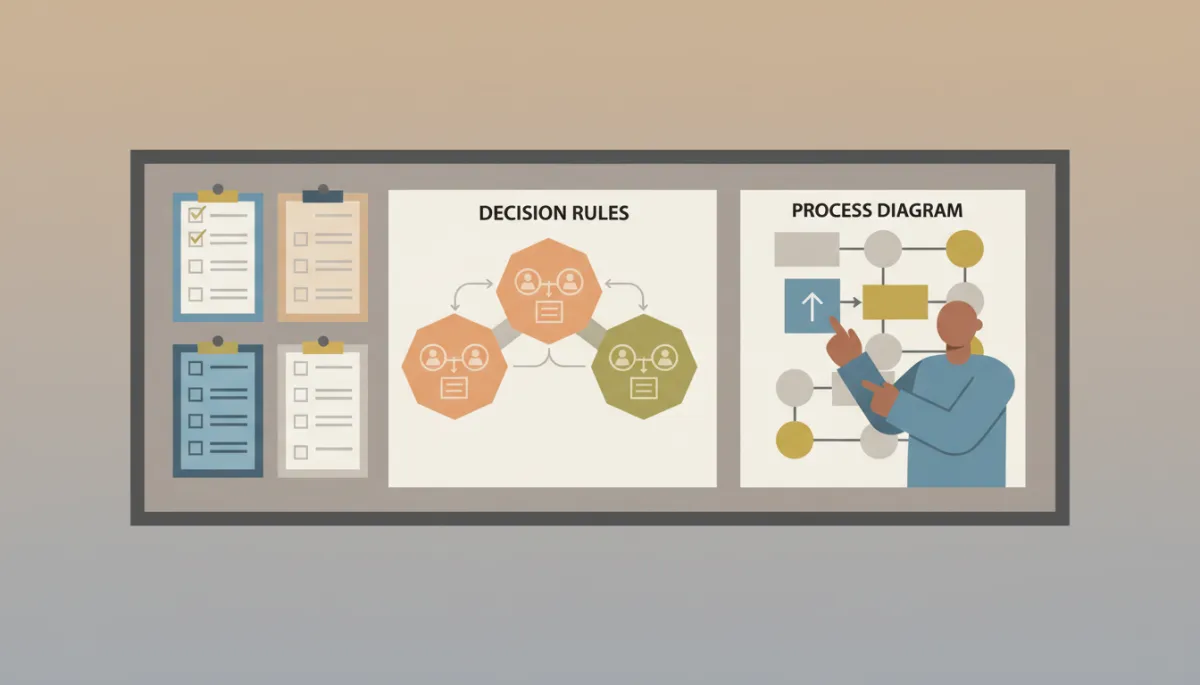
Clear decision rules turn daily operations from guesswork into a repeatable system.
Building Trust: Inside the Team and With Customers
Trust is built when people experience consistency. Decision filters and a light governance layer create that consistency both internally and externally. Inside the business, staff know what is expected and how decisions will be judged. Outside, customers know what they can count on from you every time they visit or call.
A clear refund policy, a transparent booking process, and predictable service standards all communicate the same message: this business is reliable. Over time, those patterns become part of your reputation. In competitive local markets, that kind of trust building is often more powerful than any short‑term promotion or viral trend.
Durable Assets: Building What Lasts Beyond the Next Trend
Many local businesses pour energy into things that vanish quickly—one‑off campaigns, flash sales, social posts that disappear in a day. A governance mindset shifts focus toward durable assets: the systems, relationships, and capabilities that keep paying you back for years. Decision filters help you ask, every time, “Does this create something durable, or is it just a spike of activity?”
Documented processes and checklists are durable assets—they work even when staff change.
A strong customer email list is a durable asset—unlike a single viral post, you can use it repeatedly.
Training materials, playbooks, and clear policies are durable assets—they increase your team’s capability without adding more people.
When your decision filters favor durable assets over quick wins, you gradually build a business that is more stable, more valuable, and less fragile. You are not just chasing this month’s revenue; you are investing in the engine that will generate revenue for years to come.
Reducing Dependency: So the Business Does Not Collapse Without One Person or Channel
A key goal of a governance layer is reducing dependency—on the founder, on a single staff member, or on one marketing channel. If your business only works when one person is present, or only grows when one platform performs, you do not have a resilient operation; you have a fragile one. Decision filters help you deliberately spread risk and build backup options.
For example, you might adopt a filter that says: “No single staff member should be the only person who knows how to perform a critical task.” That immediately leads to cross‑training and documentation. Another filter might say: “No more than 40% of our new customers should come from any one channel.” That pushes you to diversify how you attract and retain customers, rather than relying on a single algorithm or partner.
Improving Continuity: Keeping the Business Steady Through Change
Continuity is the ability of your business to keep operating smoothly despite staff turnover, market shifts, or personal emergencies. A governance layer improves continuity by making sure knowledge, standards, and decision rules live in the business—not only in people’s heads. When someone leaves, the way you do things remains intact. When the market changes, you have principles to guide how you adapt, instead of reacting in panic.
Continuity also matters if you ever want to sell your business or step back from daily operations. Buyers and managers value businesses with clear governance because they are easier to run and less risky. In other words, continuity is not just about survival; it also directly affects the long‑term value of what you are building.
Red Flag Trigger #1: Dependence on Virality
One major red flag for local businesses today is dependence on virality. If your growth plan is “we just need one big video to blow up,” you are building on sand. Algorithms change, platforms fade, and attention is unpredictable. A governance layer helps you treat virality as a bonus, not a strategy. Your decision filters might specify that:
You invest primarily in channels you can control (email list, local partnerships, referrals) rather than chasing every viral trend.
Any viral moment is used to grow durable assets—such as capturing email signups or loyalty program members—rather than just likes and views.
This mindset protects you from the emotional rollercoaster of “post, hope, repeat.” Instead, you build steady, compounding growth that does not disappear overnight when the algorithm shifts again.
Red Flag Trigger #2: Founder Exhaustion
Another critical warning sign is founder exhaustion. If the owner is always the first one in, last one out, answering every question, solving every problem, and carrying every worry, the business is running on borrowed time. Exhaustion is not just a personal issue; it is a structural one. It signals that the governance layer is too weak or missing entirely.
Decision filters reduce founder exhaustion by pushing authority and clarity down into the organization. Instead of “Ask the owner,” the default becomes “What do our rules say?” Over time, this shift allows the founder to move from being the chief firefighter to being the architect—spending more time improving systems and less time rescuing days. Energy returns, creativity returns, and the business can grow without consuming the person who started it.
Red Flag Trigger #3: Trend Dependency
A related danger is trend dependency—constantly reshaping your offers, branding, or marketing just to chase what is currently popular. While staying aware of trends is useful, building your entire strategy around them leaves your business directionless and confusing. One month you are the “eco” brand, the next you are the “luxury” brand, and customers do not know who you really are.
Governance helps you filter trends through your core identity and principles. A simple filter might be: “We only adopt a trend if it genuinely improves our core customer’s experience and fits our long‑term positioning.” That way, you can selectively use trends as tools, not as your entire strategy. You become a stable presence in your market, not just another business chasing the latest wave.
Leveraging Capability Without Increasing Labor
One of the most powerful benefits of decision filters is that they help you leverage capability without increasing labor. In many local businesses, the default solution to any new demand is “hire someone.” But if your systems are unclear and your decision rules are inconsistent, every new hire just adds more complexity and more training time, not more output.
With a strong governance layer, each staff member can do more meaningful work because they are not waiting for instructions or re‑creating solutions from scratch. Clear processes, templates, and decision filters act like invisible staff members—quietly doing part of the work for you. This is how you grow revenue and impact without linearly growing your headcount and payroll stress.
Putting It All Together: A Simple Governance Blueprint for Local Businesses
You do not need a thick policy manual to benefit from governance. Start small and practical. Choose a few areas where chaos, dependency, or confusion are highest—often pricing, scheduling, customer service, and marketing. For each area, write down 3–5 clear decision filters that reflect how you want the business to run. Share them with your team, invite feedback, and refine over time as you learn what works.
Use filters to reduce chaos by deciding in advance how you handle common situations.
Use them to increase ownership by giving staff authority within clear boundaries.
Use them to simplify operations by limiting options to what you can consistently deliver well.
Use them to build trust by making your service feel reliable and fair, every time.
As these filters become part of your culture, you will notice fewer emergencies, more initiative from your team, and a calmer, more focused work environment. You will also be better protected against the red flags we explored: dependence on virality, founder exhaustion, and trend dependency. Instead of reacting to every new pressure, you will be choosing based on stable principles that serve your customers and your business over the long term.
Conclusion: Build a Business That Can Breathe
At its heart, a governance layer is about giving your local business room to breathe. Decision filters turn invisible expectations into visible agreements. They protect your time, your team’s energy, and your customers’ trust. They guide you toward durable assets, reduced dependency, and stronger continuity—so your business can thrive even when conditions change or key people step away for a while.
You do not need more chaos, more trends, or more heroic effort. You need a simple set of rules that reflect what you stand for and how you want to operate. Start small, be consistent, and treat your decision filters as living tools you improve over time. In doing so, you will create a business that is not only more profitable, but also calmer, more resilient, and far more enjoyable to run—for you, your team, and your community.